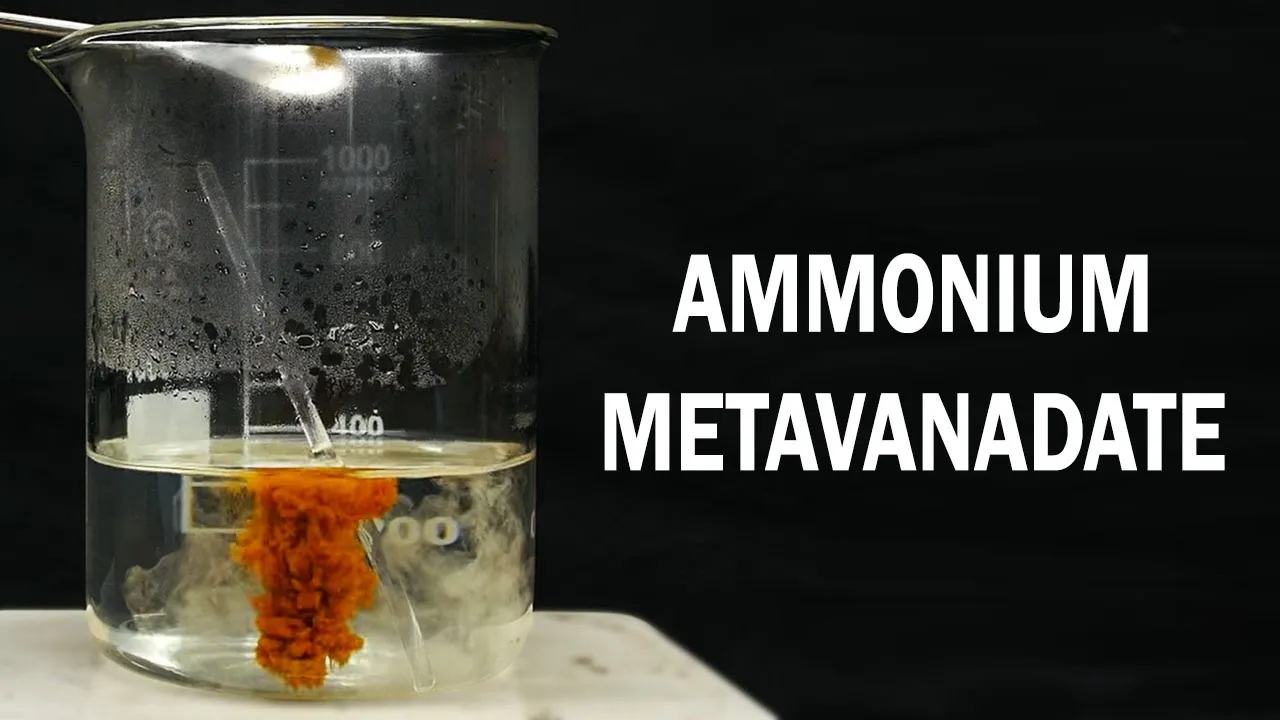
This is a quick warning, vanadium compounds are toxic, so it’s important to be careful when working with them. This also means that waste from this experiment can’t just be poured down the drain — and it must be placed in an appropriate waste container. Ammonium Metavanadate is a vanadium-based white, inorganic powder with the formula NH₄VO₃ It’s two main uses [are as] an intermediate in vanadium purification and as a catalyst in chemical reactions. I plan to use it for the latter reason to catalyze the oxidation of cyclohexanol to adipic acid.
Adipic acid is a precursor to nylon and I think it might be cool to do some polymer chemistry. Ammonium Metavanadate is also used in a demonstration called the “Redox Rainbow” and I’ll post a video on that eventually, as well. I might also make some Mandelin reagent which is pretty commonly used in drug testing kits. I don’t think I’ll be able to do any tests on illegal drugs, though, and I’ll have to stick to the ones I can legally get in Canada.
In general, vanadium is not the most common element to hear about, so I was a little bit excited to make a video on one of it’s compounds. Also, I bought about ten grams (10 g) of vanadium metal a few months ago and [I] think I’ll eventually do an element video on it. To make the ammonium metavanadate we need three main chemicals. Sodium carbonate (Na₂CO₃), Vanadium pentoxide (V₂O₅, IUPAC divanadium pentoxide) and ammonium chloride (NH₄Cl).
Sodium carbonate is pretty easily purchased online or made from Sodium bicarbonate (IUPAC: sodium hydrogen carbonate) and ammonium chloride is also pretty easy to get. Vanadium pentoxide is a little bit more exotic, but it’s still pretty easy to get because it’s commonly used in pottery and ceramics. I used the video made by TheHomeScientist as a rough guideline and I’ll provide a link to that in the description. To start things off, I add four hundred milliliters (400 mL) of distilled water to a beaker.
To the water I added about twenty-five grams (25 g) of anhydrous sodium carbonate. Using a glass stir rod, I mixed things around until everything has completely dissolved. At the same time, I turned on the hot plate and heated things up. Heating things up does help dissolve the sodium carbonate, but it’s also needed for the next step to work.
I don’t know the exact temperature that sodium carbonate solution needs to be, but I’d say something around 90 C (90 ℃) is good. Once everything had dissolved and we had our hot solution of sodium carbonate, it’s time to slowly add the vanadium pentoxide. I really need to emphasize that it’s important that it’s added slowly because this reaction produces a lot of CO₂ gas and if we added it all at once or too quickly, it could easily bubble out of the beaker. Once I got a feel for the type of portions I could add safely, I started dumping them in directly from the beaker.
The overall reaction that’s occurring here is a reaction between vanadium pentoxide and sodium carbonate to produce sodium metavanadate and CO₂ gas. This reaction only takes place at a decent rate in hot solutions and this is why we needed our sodium carbonate solution to be heated up. As I continue to add the vanadium pentoxide, the solution slowly took on a dark green murky color. Once everything had been added, I brought the solution to a gentle boil and I held it there for several minutes.
The orange color slowly faded away, but I still had this green murkiness and there was a lot of sludge at the bottom. Based on the solubility of sodium metavanadate that I found online, it should easily dissolve in this much water. It seems to be though, that this isn’t the case and we need to add more water to dissolve everything. So I kept adding small portions of water and allowing the solution to heat up and boil.
As more water was added the green color slowly faded, and eventually disappeared. I did try to add some more sodium carbonate to see if that would help, but it really didn’t seem to make a difference. In total, I added about three hundred milliliters extra (300 mL), so the final volume was around seven hundred (700 mL). There was quite a bit of solid material floating around in the solution, so we have to filter this off.
I’m not exactly sure what the particulate is, but it’s probably just impurities that came from the vanadium pentoxide. My filtering setup here is just a bunch of coffee filters placed in a dollar store funnel. It’s a pretty cheap setup, but it works quite well, and you can see a nice clear solution coming through. Our now-filtered hot sodium metavanadate solution is transferred to a clean one liter (1 L) beaker.
Twenty-five grams of ammonium chloride is dissolved in about seventy-five milliliters of water, and this is dumped directly into our hot solution. What occurs here should be a double displacement reaction, where we make ammonium metavanadate (NH₄VO₃) and sodium chloride (NaCl). Sodium chloride is very soluble in water, so it will stay dissolved, but the ammonium metavanadate should precipitate out. Eventually things had cooled down to room temperature, though, and nothing had precipitated out.
I placed the solution in the freezer for a few hours and still not too much crystallization was occurring. I left it overnight in the freezer and when I came back in the morning, there was a lot more, but it was pretty much just on the sides of the beaker. The amount of ammonium metavanadate that I have here is something like two to three grams (2-3 g) which is much less than the theoretical of fifty-three (53 g). I was honestly a little bit confused as to what was happening here, so I decided to try adding more ammonium chloride.
The twenty-five grams (25 g) that I added earlier was already more than enough ammonium chloride, so I didn’t really expect adding more to help. Apparently, though, it did help and I’m not exactly sure why this happened. A few minutes later, it didn’t seem like too much had happened, but I thought maybe it looked like a little bit more precipitate was present. I let it stand for a little while longer and this time a definite change had occurred.
A lot of precipitate had formed and this time it wasn’t just on the sides of the beaker. Like before, the beaker was placed into the freezer to precipitate as much as possible, and then I moved on to filtration. I chose to use vacuum filtration because it’s much faster, but it’s also possible to do a gravity filtration using something like coffee filters. After everything had been transferred to the filter funnel, I washed the beaker out with a little bit of water.
Once everything had been added to the filter funnel, I washed it with a small amount of cold water. Ammonium metavanadate really isn’t very soluble in water, but you still should try to limit the amount that you use in the washing steps. After washing it two to three times, I kept the vacuum on to try to dry it up. Once it seemed reasonably dry, I broke the things up with a metal spatula and I transferred it to a piece of paper.
I left it out to dry for a day or so, and then I transferred it to a storage bottle. The final yield of ammonium metavanadate was about forty-two grams (42 g), which represents a percent yield of eighty percent (80%). I used the video made by TheHomeScientist as a guideline and despite following his recommendations, I still ran into the same problem that he did. After adding the vanadium pentoxide, not everything dissolved and I had to add a bunch more water.
I also ran into the weird issue that the ammonium metavanadate didn’t really crystallize and I had to add more ammonium chloride for some reason. Both of these issues, though, probably didn’t really decrease the yield very much. Ammonium metavanadate is really not very soluble in water, so even adding more water isn’t too detrimental. So, for today I’ll actually have two questions: The first question is, can you explain why we needed to add so much excess water? Is the commonly listed solubility of sodium metavanadate wrong? Or, is there another explanation? Also, are you able to explain why I needed to add a severe excess of ammonium chloride? In the video by TheHomeScientist, he didn’t have to any excess, and it simply crystallized out as the solution cooled.
I used pretty much the same amount of each reagent that he did, and I’ll provide the amounts here. One thing to remember is that I don’t actually have answers for either of these questions, and I’m honestly just interested to see what you guys have to say. As usual, I’d like to thank everyone who’s supporting me on Patreon. Anyone who supports me with five dollars ($5) or more will get their name at the end of the video, like you see here. Eventually, I hope to get some tiers going, and also add some more rewards to the one dollar ($1) and five dollar ($5) tier.
Anyway, these are the videos that I’ve already filmed and the ones that I plan to film. If you have any suggestions, please let me know in the comments.
Nature’s Way Sambucus Black Elderberry Gummies with Vitamin C and Zinc, 60 Gummies

Source: NileRed
Comments
Post a Comment